Has your software vendor introduced AI since you signed the contract? Here's why technology contracts should be reviewed as platforms evolve.

Larissa Hamilton
Director | HAVN Law
AI
/
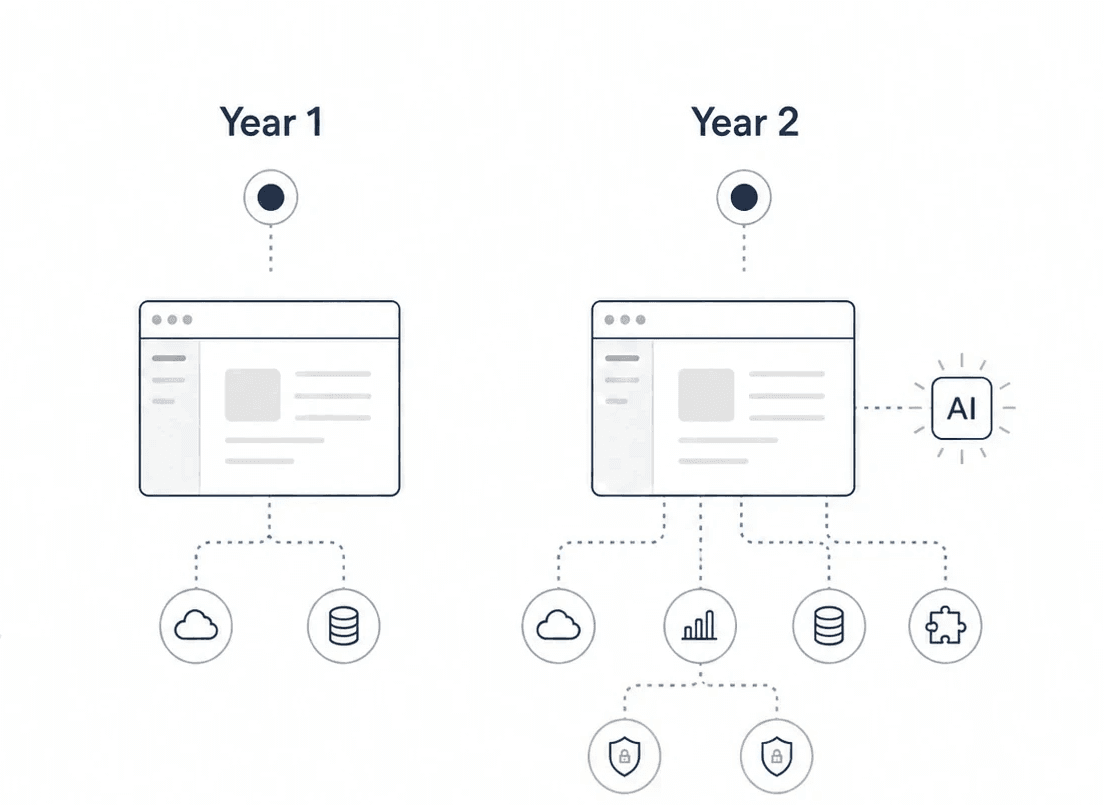
The changing nature of technology contracts
The technology contract you signed two years ago may not reflect the supplier relationship you have today.
When you sign a technology contract, you're not just agreeing to what the product does today. You're also accepting some risk around how it may evolve.
Two years on from signing, the supplier may have added AI-assisted functionality, expanded reporting or analytics tools, introduced new integrations with third-party services, or altered the way information moves through the platform.
Some of those changes may be beneficial, but that is not the same as asking:
Does the platform still align with the customer’s risk appetite, operational needs and governance settings?
That matters because a customer’s leverage reduces after implementation, when vendor lock-in becomes real. Once operational data sits inside the system, or that system is integrated deeply across an organisation and staff rely on it daily, unwinding the relationship is not easy.
This means technology contracts need to do more than describe the service accurately at the start. They also need to preserve visibility, control and exit options as the platform evolves, including clear notice rights and practical consequences if a change materially alters the customer’s risk position.
AI governance is not only about internal AI policies or employee use of AI tools. It also needs to cover AI functionality introduced by suppliers into platforms the organisation already depends on.
That means assessing the supplier relationship throughout its lifecycle, not just at procurement.
Contract Reviews
For key suppliers, a six-monthly review can be a practical safeguard, bringing the right stakeholders together to ask:
1. Is this still the service we assessed, contracted for and approved?
2. Has AI functionality been introduced, expanded or switched on by default?
3. Were we notified of material changes in time to assess their impact?
4. Do any changes require a fresh privacy, security, legal or risk review?
5. Have data flows, subprocessors, integrations or hosting arrangements changed?
6. Are staff using the platform in ways that were not originally assessed?
7. Are the supplier’s security certifications and assurance reports, such as SOC 2 and ISO 27001, still current and relevant to the service?
8. Has reliance on the supplier increased?
9. Does current use still align with internal governance, privacy, security and risk settings?
If something material has changed, the customer may be able to ask for clarification, require updated assurance, switch off functionality, restrict internal use, object to new data uses or subprocessors, seek a contractual variation, or start planning for exit if the risk profile has changed. But this is all contract and relationship dependant.
Technology supplier risk is not static. A platform can be appropriate when signed, but materially different by year two.


